

Basic training module for the "School Dream Gym" (SSM)
What is this about? (the heart of the idea)

We don't sell "hardware"
WE ARE BUILDING A LESSON!
SSM is a complete system for conducting Strength and Health Lessons (LSiZ) – classes that teach safe resistance training, improve health, posture and self-confidence.
The system includes:
-
Main module – multifunctional machine TRX-17-SSM (School Module),
-
4 additional stations – simple devices for implementing the most important movement patterns,
-
Floor with markings – for setting up classes and learning technology,
-
Free weight set – dumbbells and bars in safe weight ranges,
-
Boards with pictograms and QR codes – leading to short instructional videos,
-
Lesson plans and scenarios – ready-made materials for teachers.
One module, over 1000 exercises, 30 students – in approximately 44 m² (space for 15 students at a time, ≥55 m² when the entire group of 30 people works in rotation).
Why so?
Because a good school gym is about emotions, safety and progress, not a "machine warehouse".
Bad gym = money spent, little use. Good gym = generational change.
What to buy? (SSM core room)
This isn't a "simple set"—it's a premium core that provides a complete lesson for the entire class.
Classroom Capacity: Up to 15 students at a time in comfort; up to 19 in a denser arrangement; up to 30 students in rotation (1 on / 1 off – half practicing, half resting and rotating between sets).
Variability: Over 1000 exercises covering full movement patterns (squat, deadlift, push, pull, extension, flexion, rotation) and isolation exercises; double/single leg, double/single hand versions.
Safety: silent load stacks (closed load), smooth-running guides, locks and click adjustments for quick adjustment to the user's height.
Education: pictogram at each station + QR code leading to a 30-60 second technique video.
Core: TRX-17-SSM – Training Module (TRX-17-SSM)
Four additional positions
Simple, "bulletproof" devices for implementing movement patterns that the class performs most often:
Pushing/pulling in a horizontal plane – e.g. rowing, bench press,
Knee flexion/extension – activation of quadriceps and back of the thigh muscles,
Spinal extension/antiflexion – protection and stabilization of the spine,
Pull-ups/Dips – assisted versions, with belaying for complete safety.
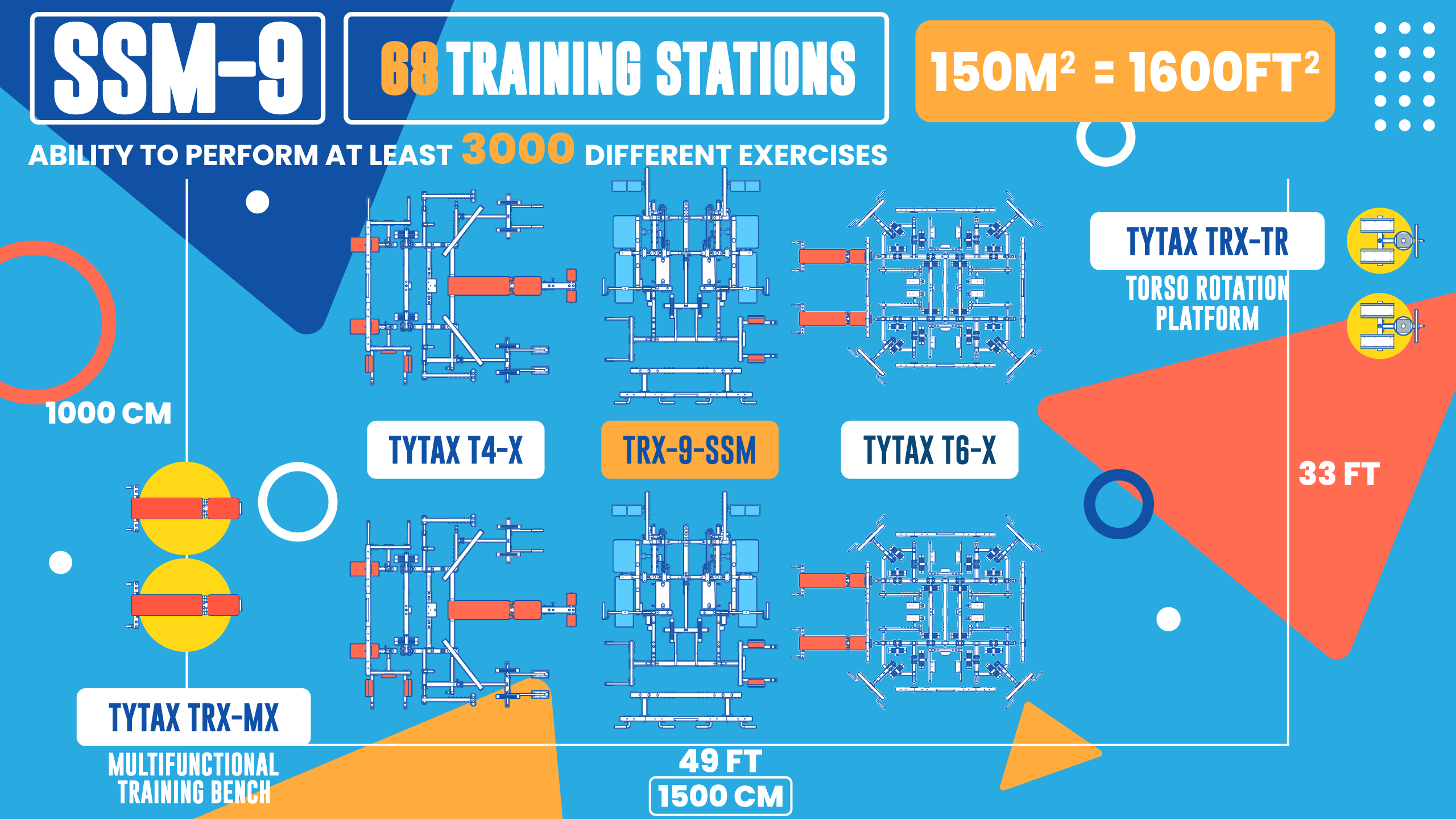
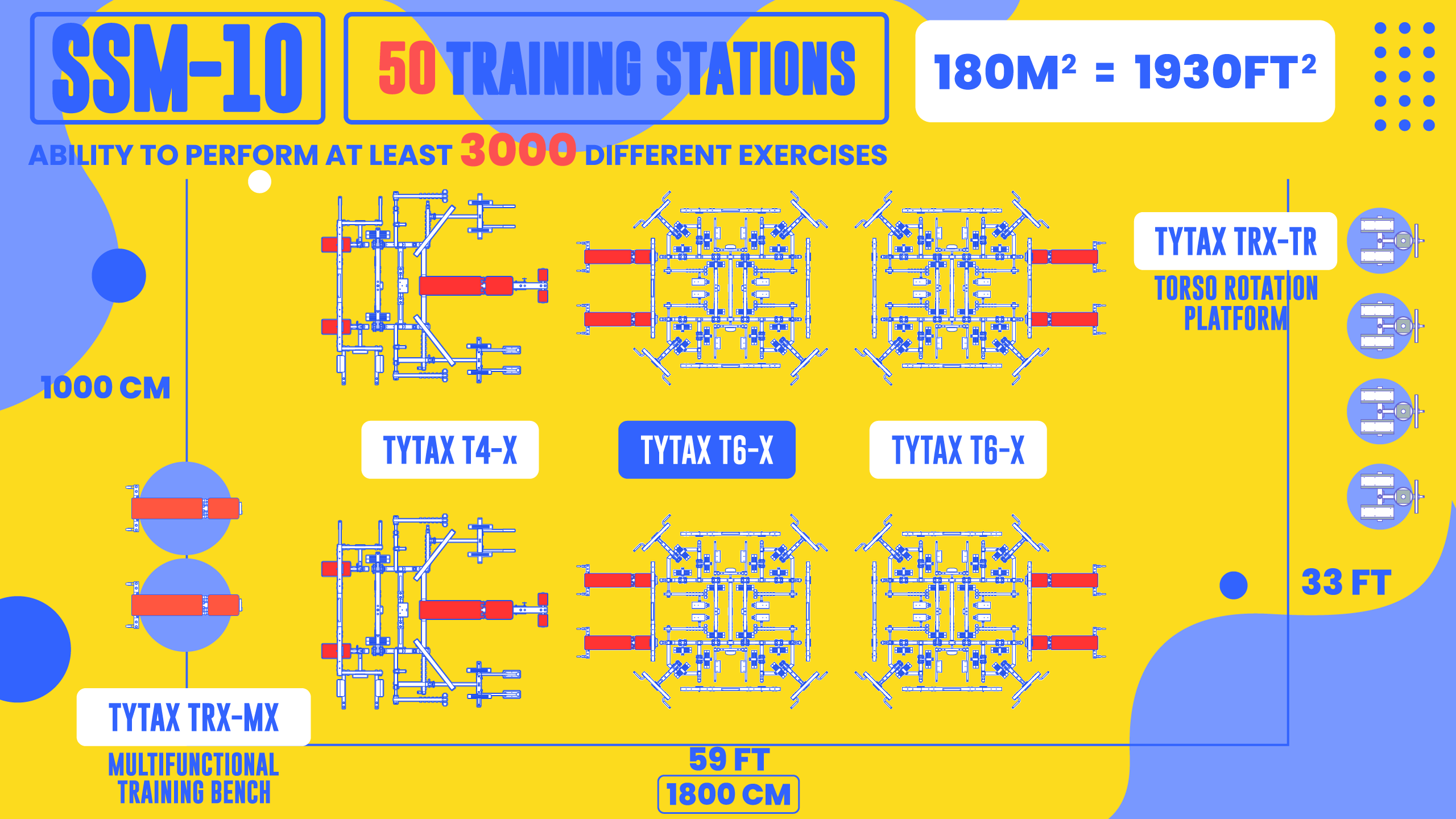
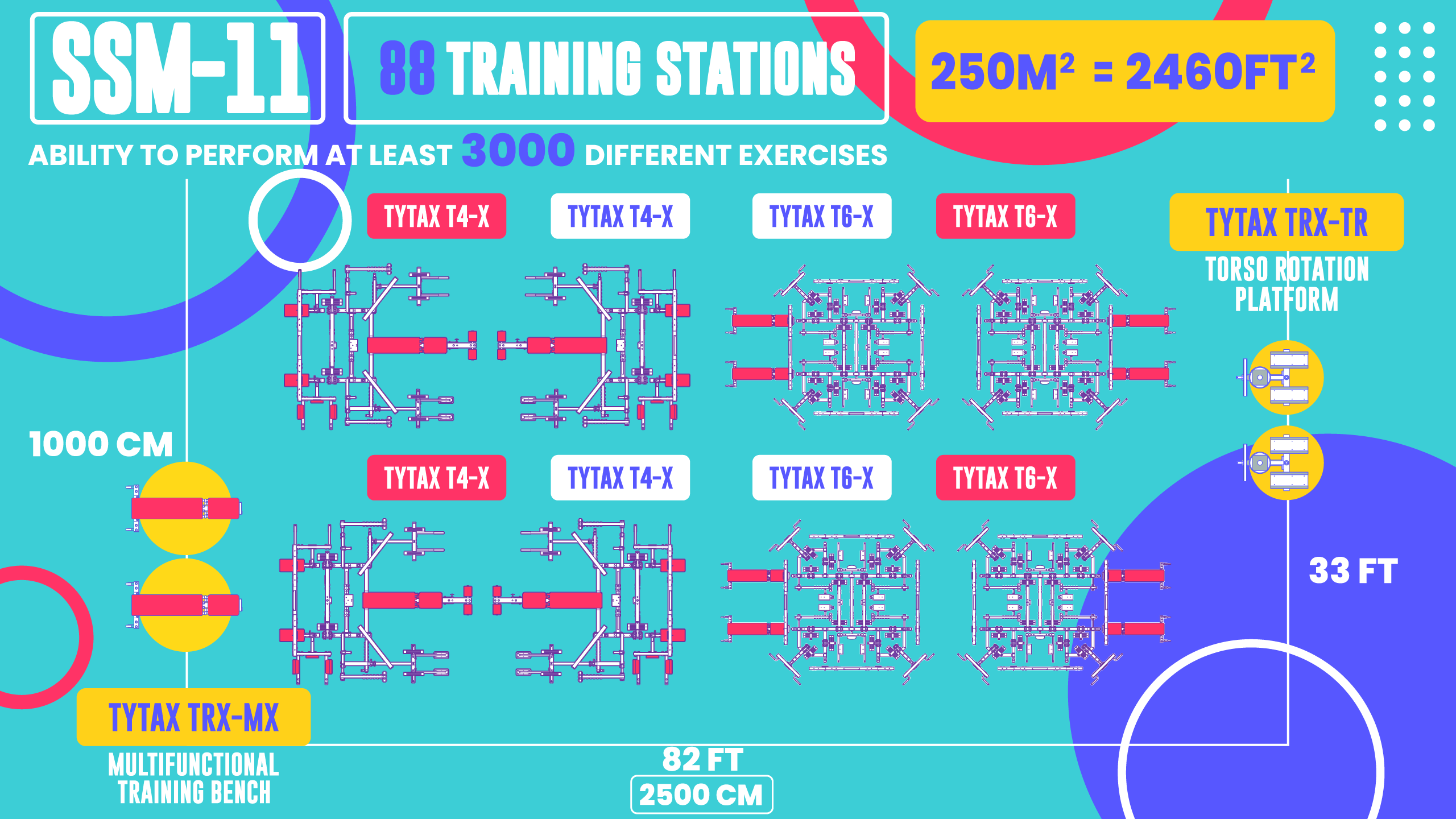
Example training module configurations
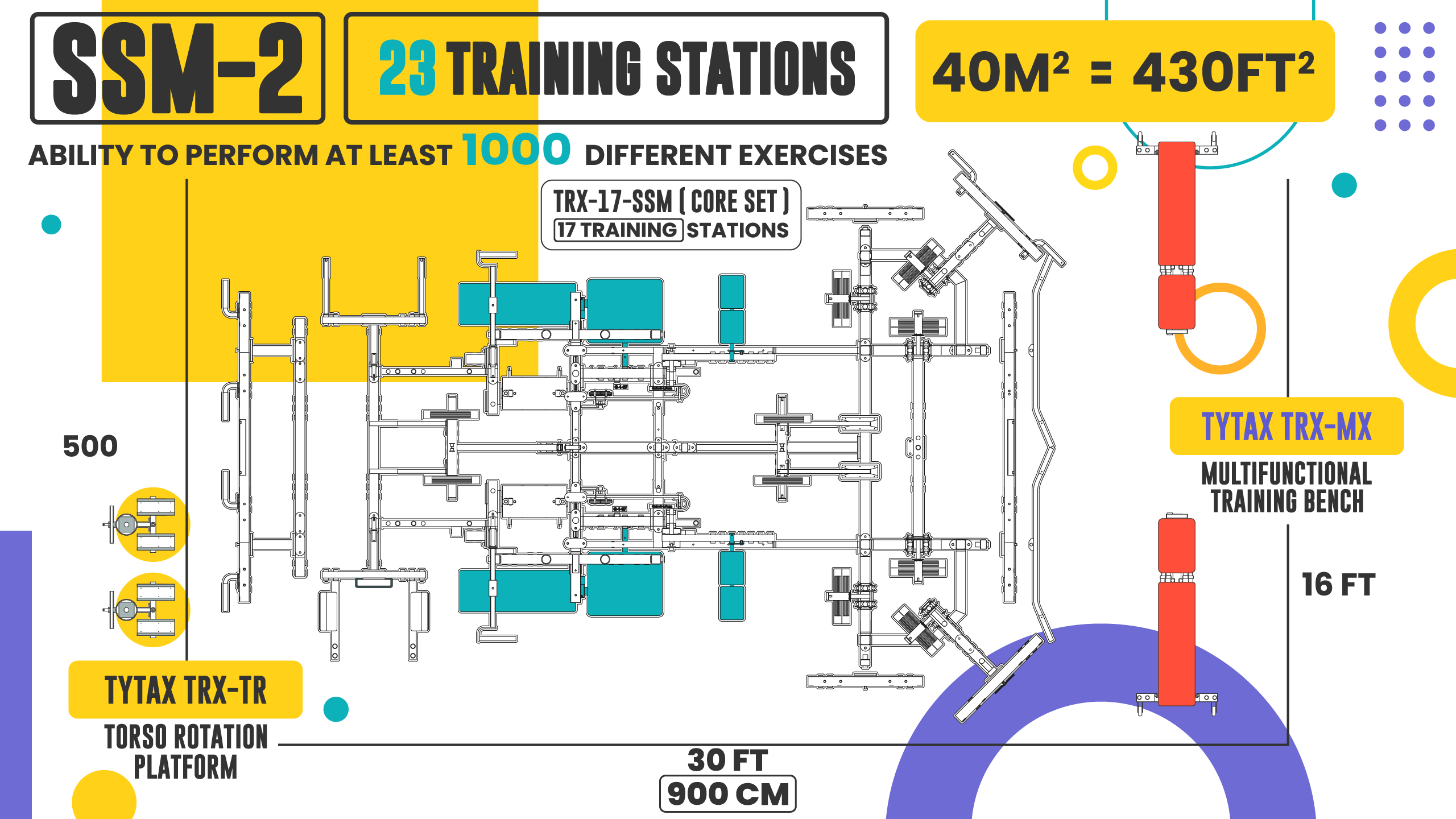
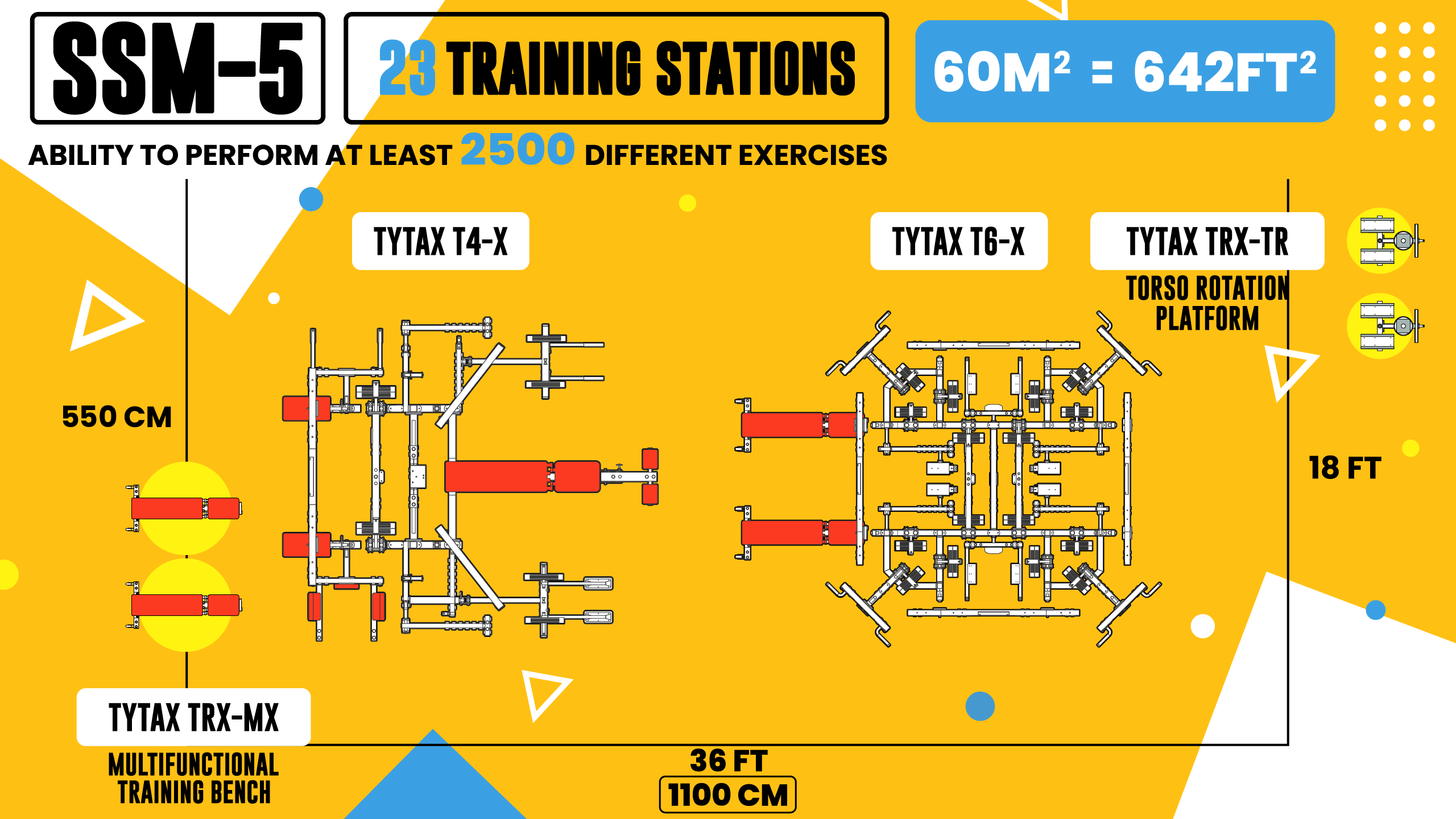
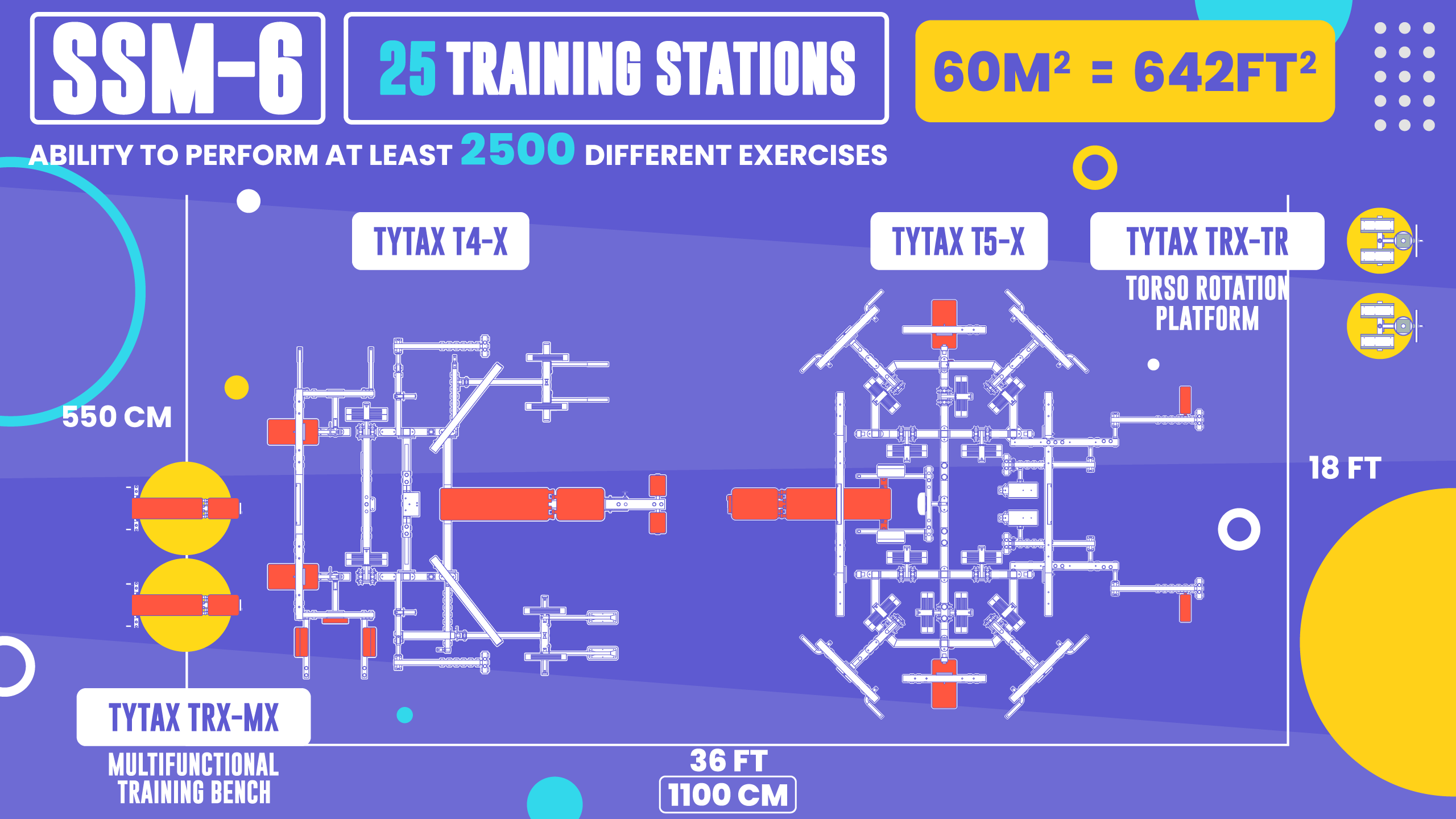
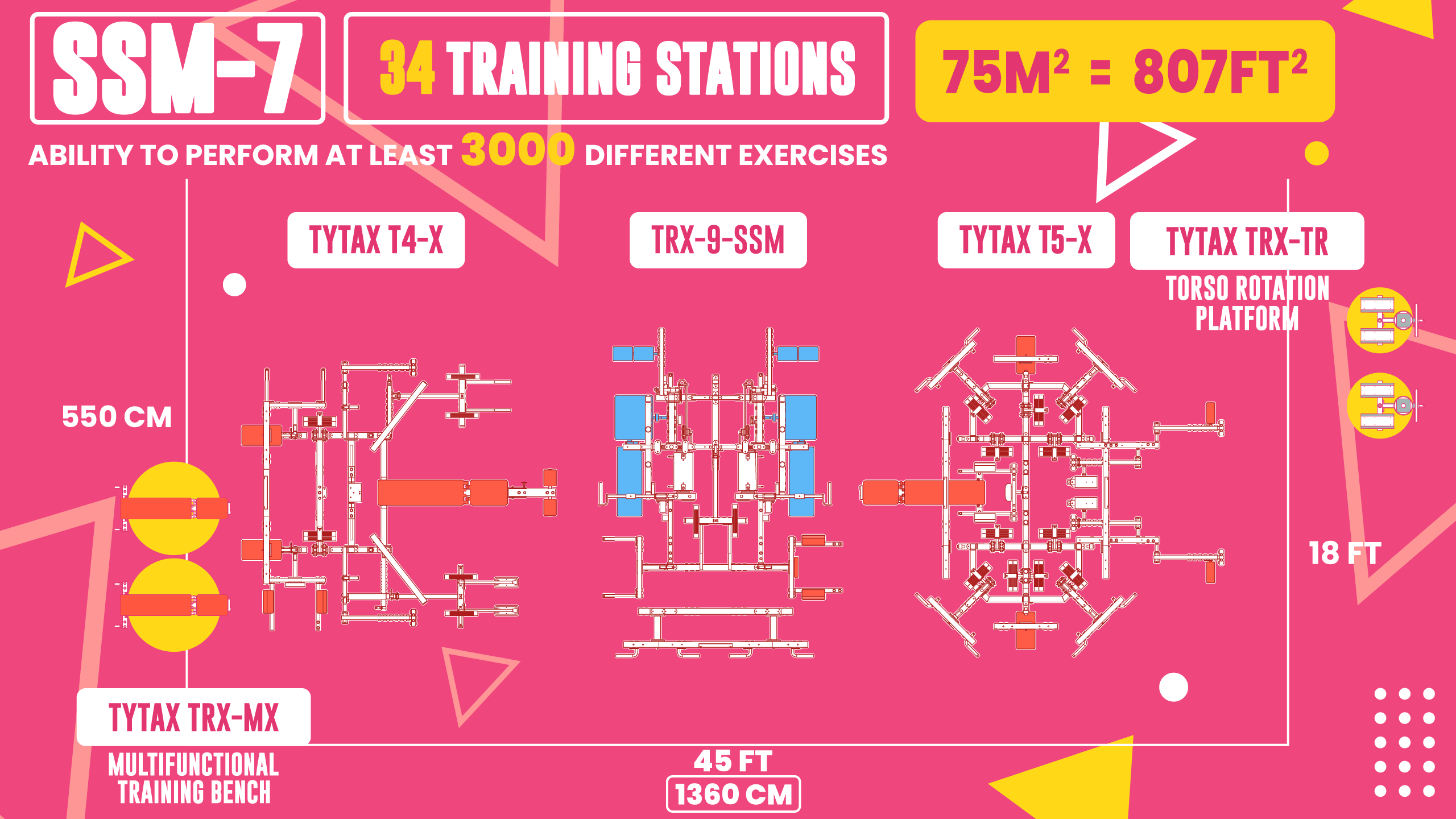
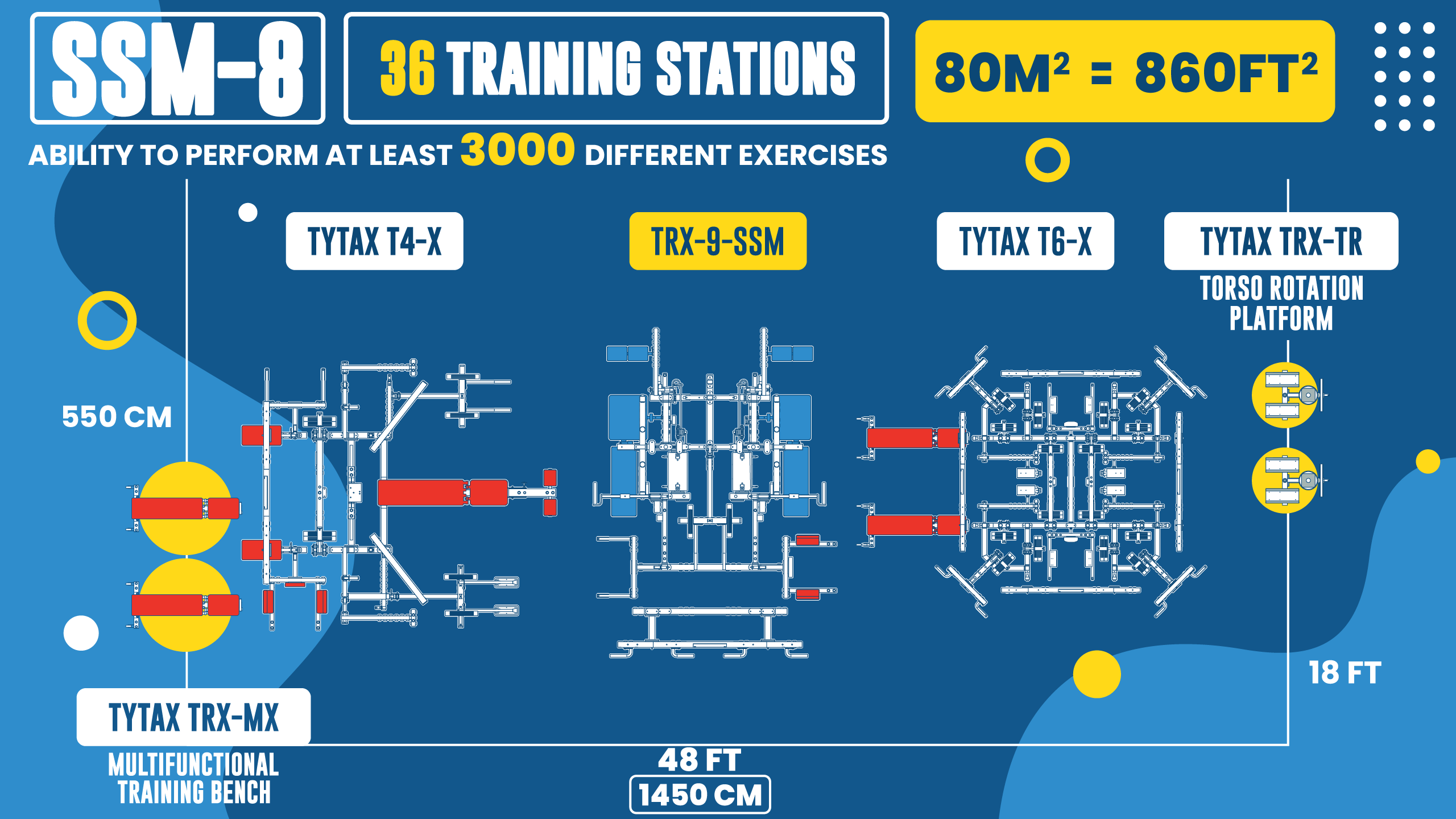
– from 13 to 88 training stations
Zones A / B – for two halves of the class,
Positioning arrows and starting lines – help reinforce proper movement habits,
Safety fields at the stations – they designate the space that we do not cross during the series.
Floor markings (safe order):


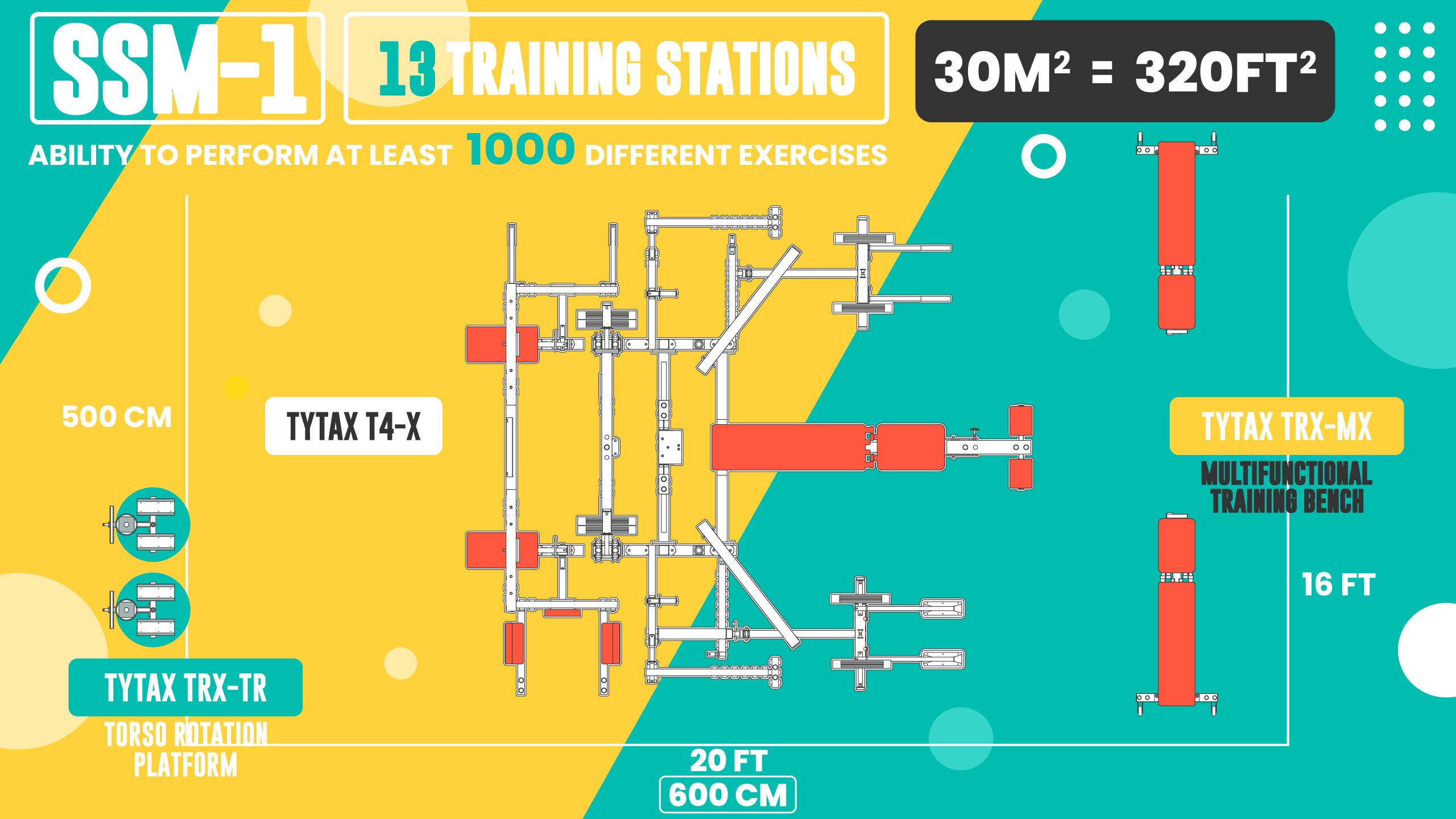
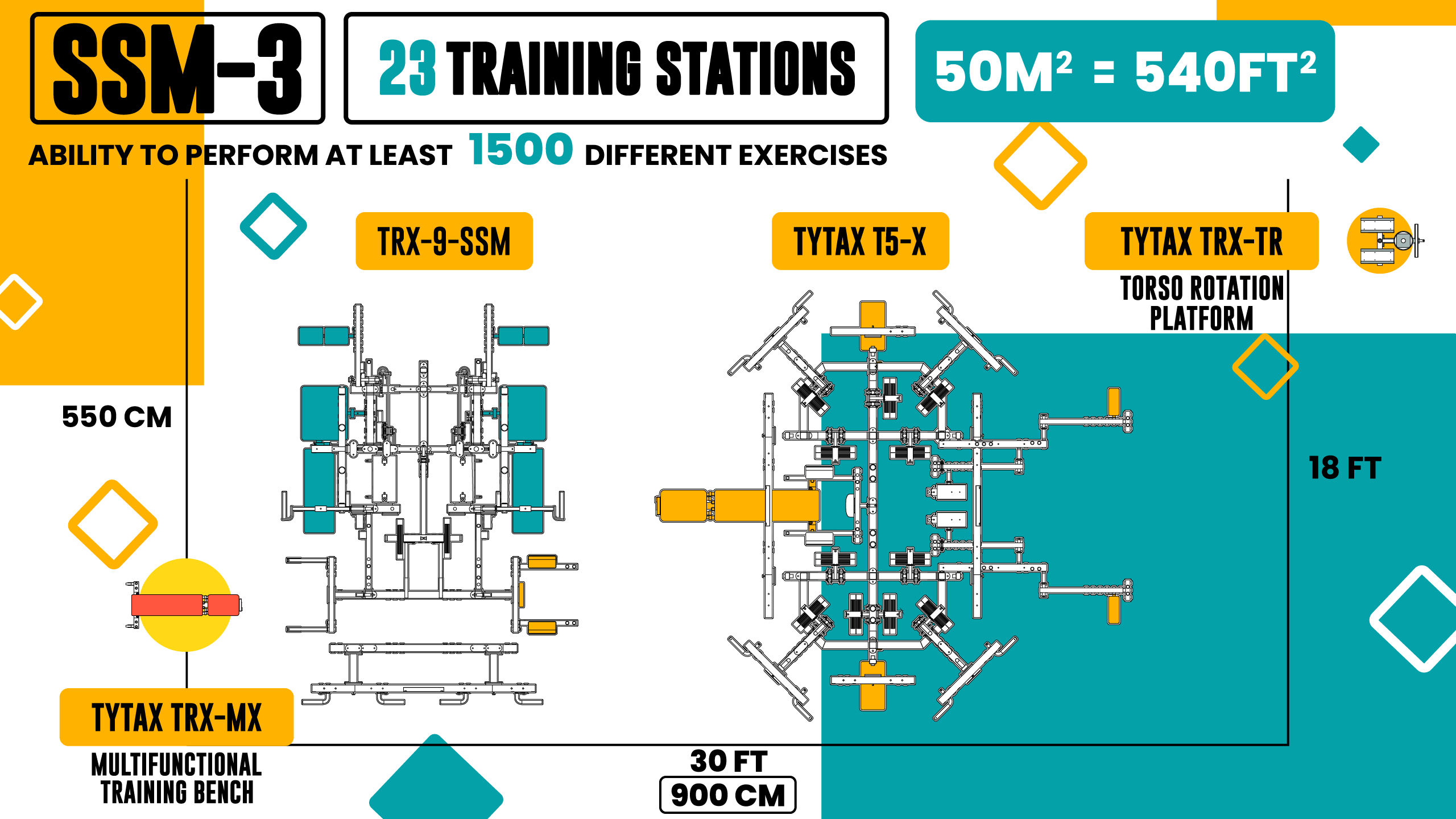
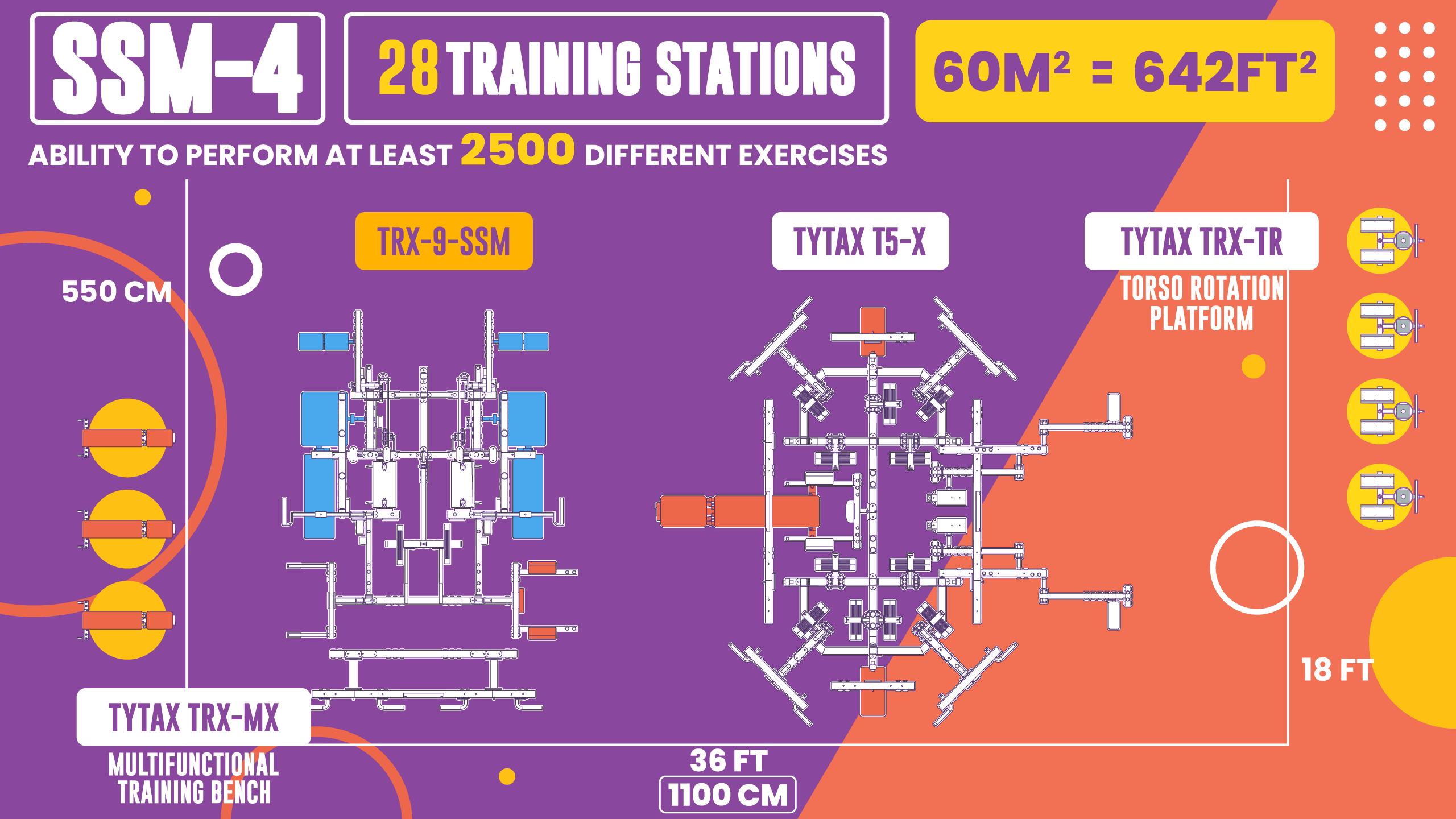
Free weights (educational kit):
Dumbbells in small increments – e.g. every 1–2 kg,
School bars/barbells – lighter and shorter, adapted to the age of students,
Weights with locks – enable quick and safe weight changes,
Belts / straps – for learning muscle tension and movement control.
What does a sample 45-minute lesson look like? (diagram)
Entry and setup (2–3 min) – the class is divided into A/B zones; the teacher has full visibility of the group.
Warm-up (5–7 min) – simple full-body movements, breathing exercises and activation of muscle tone.
Main task (20–25 min) – 2–3 movement patterns performed at stations (e.g., push + squat + anti-flexion). Rotation every 60–90 seconds.
Technical focus (5 min) – short corrections: tempo, range of motion, technique control.
Ending (3–5 min) – relaxation and a note: “what can I do better than last week?”
Progress = motivation.
The student sees his or her development – more repetitions, better technique, more stable posture.
For whom? (children, teenagers, adults, seniors)
The system is intergenerational – the school hall can also be used after classes in the MSSM formula (Intergenerational School Dream Gym), connecting students, parents, grandparents and the local community.
Children and adolescents:
-
learning body control, developing fundamental strength, preventing posture defects.
Adults:
-
improving the skills needed at work and in everyday life – lifting, carrying, bending without pain.
Seniors:
-
balance, bone density, joint protection; "safe strength" programs.
Security and supervision:
Closed weight (stacks) minimizes the risk of dropping the load.
Click-and-go adjustments allow for quick adjustment to height and limb length.
Safety zones on the floor teach order, appropriate distance and spatial awareness.
QR videos remind you of proper technique in 30-60 seconds.
Constant teacher supervision – the layout of the room allows full visibility of all students.
Starting area: approx. 44 m² – a typical module providing the necessary space for exercise.
In practice, the recommended area for 30 people exercising in shifts is at least 55 m², which guarantees comfort and safety of classes.
Floor: stable, non-slip, with vibration damping system; clear markings of exercise and safety zones.
Acoustics: Quiet weight stacks and rubberized elements provide sound comfort suitable for a school environment.
Power/IT: Standard socket for connecting a screen or player; Wi-Fi access for enjoying video content via QR codes.
Space, acoustics, installations:
Service, durability, warranty:
Simple mechanics and availability of consumables for at least 30 years ; remote support ensures minimal downtime.
TYTAX machines are designed for long-term operation in school conditions – with an operational potential exceeding 30 years.
Initial training for teachers and a set of supporting materials (worksheets, checklists) guarantee a safe and effective start to the program.
-
A clear goal for the sponsor: "1 module = 1 full class at a time" – the effect is visible immediately after implementation.
-
Phased: start with a basic module, and after a year the possibility of expansion to the CORE / FLAGSHIP version (second module, more stations).
-
Sources of financing: Parents' Council, local sponsors, participatory budget, health and educational grants.
Budget and support:
Micro-ROI SSM (in short: "what pays off?")
Durability: A long equipment life cycle means lower annual depreciation.
Less downtime: easy maintenance and parts availability translate into more hours of training.
Fewer injuries = less absences: Strength development stabilizes joints and the spine, reducing overload in young athletes.
After-school use (MSSM): the room operates after school hours – a real social and health return.
Coherent curriculum: eliminates the need for “impulse purchases” of equipment with low educational value.
Why not treadmills and a "one-motion atlas"?
A treadmill, elliptical trainer, or single atlas does not teach complete movement patterns or postural control.
Strength – with resistance adapted to the student – is the most comprehensive health stimulus: it strengthens bones and muscles, improves blood glucose, posture and well-being, and at the same time motivates with visible progress.
-
See it live – schedule a lesson demonstration in a working SSM room.
-
Choose the START configuration (~44 m²) – REX 17 + 4 stations + floor markings + screen/QR + clock.
-
Teacher training – 3–4 hours of implementation and a set of teaching materials.
-
Expansion plan – Year 2: Add a second module and more stations, expanding the room's capabilities.
How to start?
Glossary (simple and short):
SSM – School Gym of Dreams: the standard strength training facility for schools.
MSSM – Intergenerational School Dream Gym: the same standard, also available after school – for parents and seniors.
LSiZ – Strength and Health Lesson: classes based on learning how to work safely with resistance.
Module (REX 17): multifunctional TYTAX machine – the “heart” of the gym, allows for hundreds of exercises.
Load stack: weight enclosed in a guide (no loose plates), with a pin for quick load change
-
Pictogram: a drawing showing correct body positioning.
-
QR code: a square code that, when scanned, opens a short video with exercise instructions.
-
1on/1off rotation: half the class exercises, half rests – switching after each set.
Movement patterns: basic movement “families” – squat, hip hinge (deadlift), push, pull, overhead press, anti-flexion/anti-rotation.
ROI (Return on Investment): return on investment – more useful hours, fewer injuries, longer equipment life.
The 80/20 rule: 20% of exercises (full patterns) produce 80% of the effect (health and fitness); the remaining 20% are supplements.
FAQ
-
1. Is this room safe for children?
Yes. The core is built around enclosed weight stacks, click-lock adjustments, and clearly defined floor zones. Each station has a pictogram and QR code with a 30-60-second technique refresher video.
FAQ
-
2. How much space do we need to start?
We recommend approximately 44 m² (range 40–55 m²). In this space, we conduct a full lesson for the entire class on a one-on/one-off rotation.
FAQ
-
3. Can a PE teacher cope without a "gym trainer"?
Yes. We provide 3-4 hours of onboarding training, ready-made lesson plans, and worksheets.
FAQ
-
4. Can students of different heights and strengths practice together?
Yes. Adjustments and small load "steps" allow you to fine-tune the task in seconds.
FAQ
-
5. Can the room be used after classes (parents, seniors)?
Yes. This is the MSSM model – the same room operates in the afternoons for the local community.
FAQ
-
6. What if something breaks?
TYTAX machines are serviceable for years to come. We provide remote support, parts availability, and simple maintenance procedures.
FAQ
-
7. Why do we need markings on the floor?
So that the classroom is visible to the teacher and students have clear positioning points and safety areas.
FAQ
-
8. Aren't treadmills/bikes enough?
Basic health requires strength—full movement patterns with controlled resistance. Cardio is an additional option (treadmills, elliptical machines, etc.). But cardio training of incredible quality and efficiency can be achieved with TYTAX-SSM training modules.
FAQ
-
9. How many students can practice at one time?
On the REX 17 module, comfortably 15, maximum 19, the entire class ~30 in rotation.
FAQ
-
10. What is the approximate cost and how to finance it?
The START configuration is a premium core without the "gadgets." Funding: RR, local sponsor, BO, grants.
FAQ
-
11. Is consent from the sanitary inspection/inspector required?
We use solutions that meet school standards. We provide implementation assistance with checklists.
FAQ
-
12. When will we see the first effects?
After 2–4 weeks, you will see improvement in postural control; after 8–12 weeks, you will see significant strength progress.
Let's introduce the Strength and Health Lesson at your school
Schedule a lesson demonstration |
Request a quote START
We will show you a working SSM room,
We will select a START configuration tailored to your space (40–55 m²),
We will train your staff in 1 day.