

School Dream Gym (SSM) – modules that scale with your school

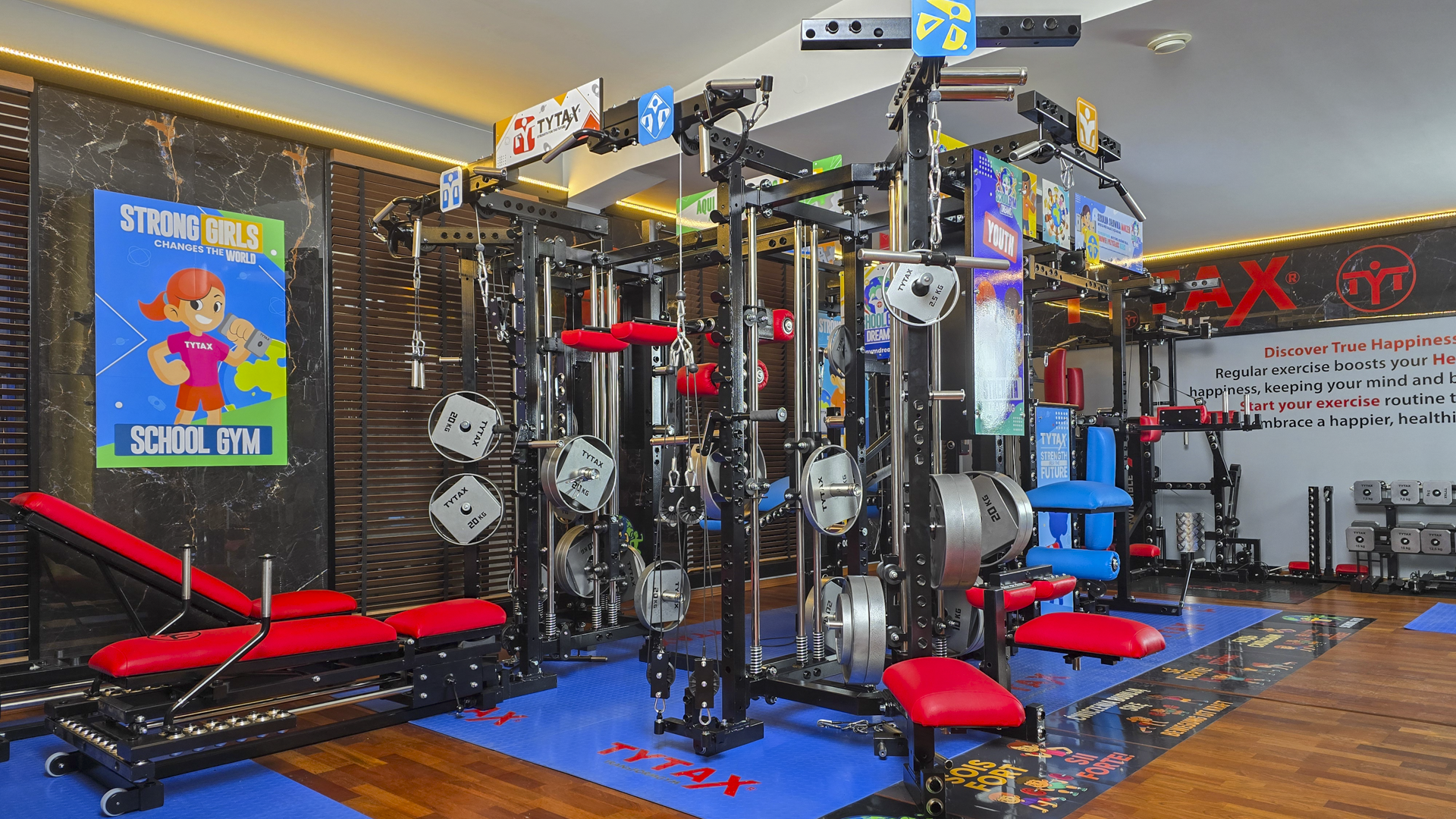
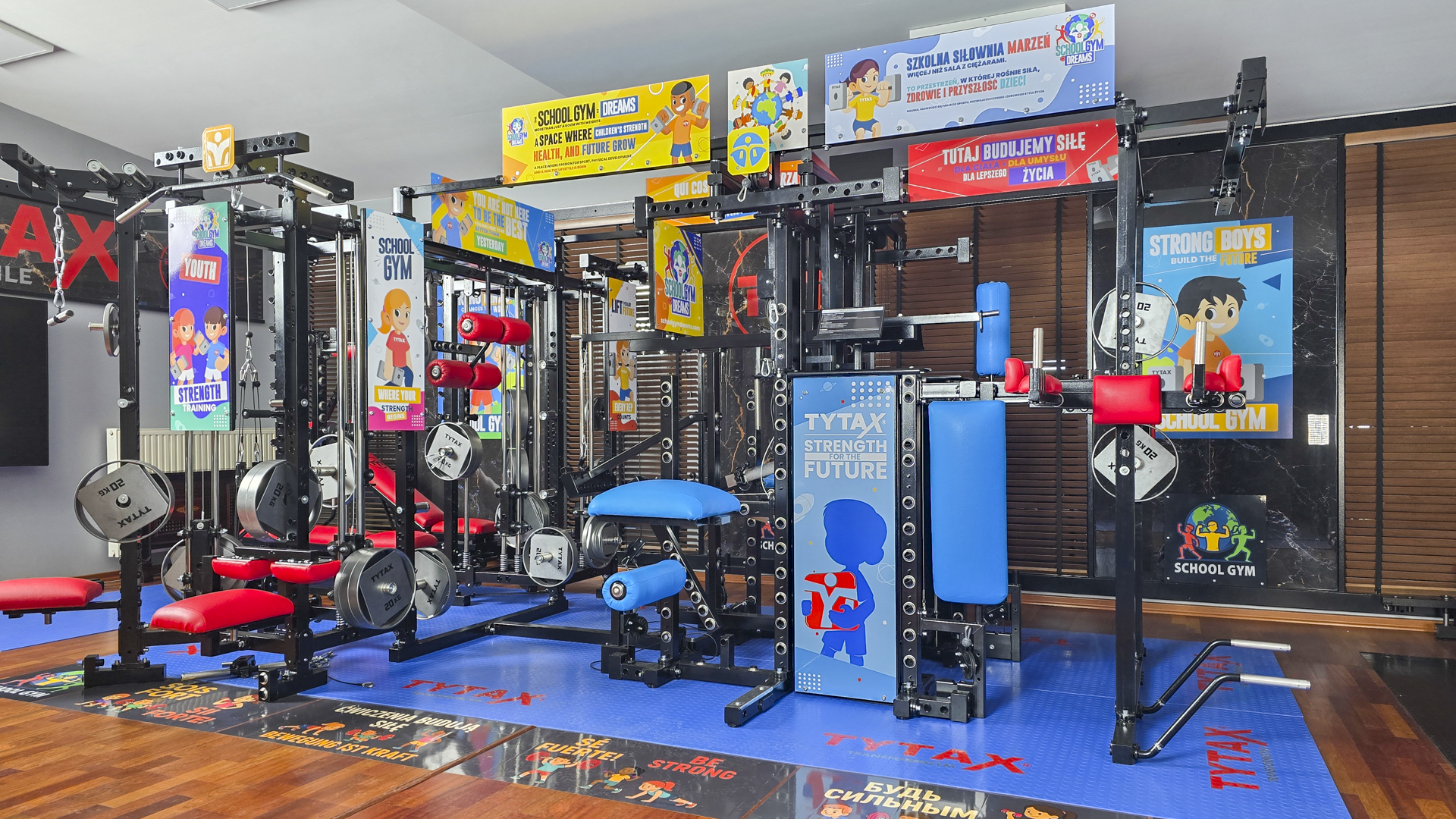
SSM is a standardized, multi-functional school gym system designed to provide a full range of strength and cardio exercises in a very small space .
The key is module duplication: instead of multiplying machine types, we duplicate proven units (e.g. TYTAX T4-X, T6-X), maintaining a uniform lesson program, operation and service.
The result? Incredible density of effective training and easy scalability—from a small 30m² room to large facilities of 250m² and more.
The most important advantages:
Compactness and density: starting from just 30 m² (SSM-1) , we can achieve 13 stations and over 1,000 exercises. In the SSM-11 layout, a surface area of 250 m² provides 86 stations (~3 m² per station).
Multifunctionality: a single TYTAX module offers hundreds, even thousands, of exercise variations. Total set: ≥1000 / 1500 / 2500 / 3000 exercises – depending on the SSM type.
One methodology for all: children, adolescents, adults and seniors exercise according to the same scheme – the same equipment, the same biomechanics, the same instructions
Rapid capacity expansion: adding another module provides an additional 8-12 seats without having to change the room logic.
Safety and ergonomics: fixed layout, repeatable distances, easy supervision; the instructor can see the entire group and conduct parallel lessons on both sides of the room.
Small-room fit (High): ideal for adapting small spaces (30–50 m²), container modules and rooms with limited space (dormitories, military units, ships).
Power Runner & Perfusion: The system supports lessons focused on perfusion, strength and performance; integration of Power Runner exercises as a cardio-perfusion component is possible.
How it works - module duplication
Instead of a complex mix of devices, SSM is based on duplicating 2-3 module types (e.g. TYTAX T4-X, TYTAX T6-X ). This allows:
the teacher shows one movement and the students immediately reproduce it in parallel on twin stations,
service, parts and staff training are simpler and cheaper to maintain,
Standardization of lesson content is easy to maintain between different classes and schools.
Examples of SSM variants (area → stations → exercises)
SSM-1
Surface:
30 m²
Positions:
13
Exercise capacity (min.):
≥ 1000
Recommendations:
Small rooms – program start.
SSM-2
Surface:
40-45 m²
Positions:
23
Exercise capacity (min.):
≥ 1000
Recommendations:
Two parallel micro-zones.
SSM-3 / 4
Surface:
50-60 m²
Positions:
23-28
Exercise capacity (min.):
≥ 1500
Recommendations:
Classes of 20-28 people.
SSM-6
Surface:
60 m²
Positions:
25
Exercise capacity (min.):
≥ 2500
Recommendations:
More strength training options and cardio training.
SSM-7
Surface:
75 m²
Positions:
34
Exercise capacity (min.):
≥ 3000
Recommendations:
Two large subgroups in parallel.
SSM-9
Surface:
150 m²
Positions:
68
Exercise capacity (min.):
≥ 3000
Recommendations:
Hall / military unit.
SSM-10
Surface:
180 m²
Positions:
50
Exercise capacity (min.):
≥ 3000
Recommendations:
Schools with larger rooms.
SSM-11
Surface:
250 m²
Positions:
86
Exercise capacity (min.):
≥ 3000
Recommendations:
Large schools/training centers.
SCALING TIP: Each subsequent TYTAX module increases the number of stations without the need to change the work methodology.
The SSM-11 layout can be expanded, for example, to 350 m², gaining approximately +50 additional stations while maintaining the same logic of conducting classes.
Schools and local governments – implementation of the “Lesson of Strength and Health” program at a national standard, from small classrooms to large training centers.
Military/NATO units – compact power plants in barracks, field modules and adaptations of existing rooms.
Police / Fire Department / services – fast, durable and resistant training zones in fire stations and operational bases.
Ships/Confined Spaces – “space-saving” variants that provide the same capacity in a smaller area.
For whom:
Lesson organization and capacity:
86 stations / 250 m² = approx. 3 m² per person – record density of effective training while maintaining comfortable passages and safety zones.
The lesson is conducted symmetrically: the teacher demonstrates the movement and two groups practice simultaneously on both sides of the room.
Training microcycles: basic strength → technique → perfusion/cardio (e.g. Power Runner ) → mobility and flexibility.
Security, service and purchasing compliance
Consistent ergonomics:
-
Repeatable distances, handles and movement patterns facilitate health and safety control and maintaining order in the room.
Uniform service:
-
Duplicate modules mean the same spare parts and maintenance schedules, which lowers the total cost of ownership ( TCO ).
Public procurement:
compatibility with tenders such as "small room / room conversion" , "multi-station / functional trainer" , "design & equip" ,
possibility of offering in the "brand-name or equal" formula,
compliance with TAA/BAA regimes (USA) and optional compliance with NATO AQAP standards.
What the customer receives (implementation package):
1. System design (SSM-1…SSM-11):
-
adapted to the size of the room and the number of students or users.
2. Job specifications:
-
list of the number and type of TYTAX modules and auxiliary accessories.
3. Lesson program:
-
ready-made training unit scenarios, exercise progression and safety rules.
4. Staff training:
-
in the field of equipment operation, teaching methodology and basic technical inspections.
5. Service plan:
-
along with a schedule of periodic inspections and recommendations for equipment maintenance.
Modularity = Simplicity: One hardware and lesson logic – scaled by duplication.
Multifunctionality = complete program: strength, endurance, mobility, cardio-perfusion - without the need for many different machines.
Compactness = accessibility: you will implement SSM where previously "there was no room for a gym".
Why does SSM work?
Do you want to choose an SSM variant for your classroom (30–250 m²) or prepare a layout for a tender (school, municipality, army, police, fire brigade, NATO)?
Write to us.
Within 48 hours, you will receive a layout proposal, a list of positions, and a variant cost estimate tailored to your needs.
Layout design (SSM-1 to SSM-11) – adapted to the room size and the number of students or users.
Specification of the stations – a list of the number and type of TYTAX modules and auxiliary accessories.
Lesson program – ready-made training unit scenarios, exercise progression and safety rules.
Staff training – in the use of equipment, teaching methodology and basic technical inspections.
Service plan – including a schedule of periodic inspections and recommendations for equipment maintenance.